
The Mitochondrial Upgrade: How 'Ghost' Particles Deliver Precision Repairs to the Powerhouses of Aging Cells
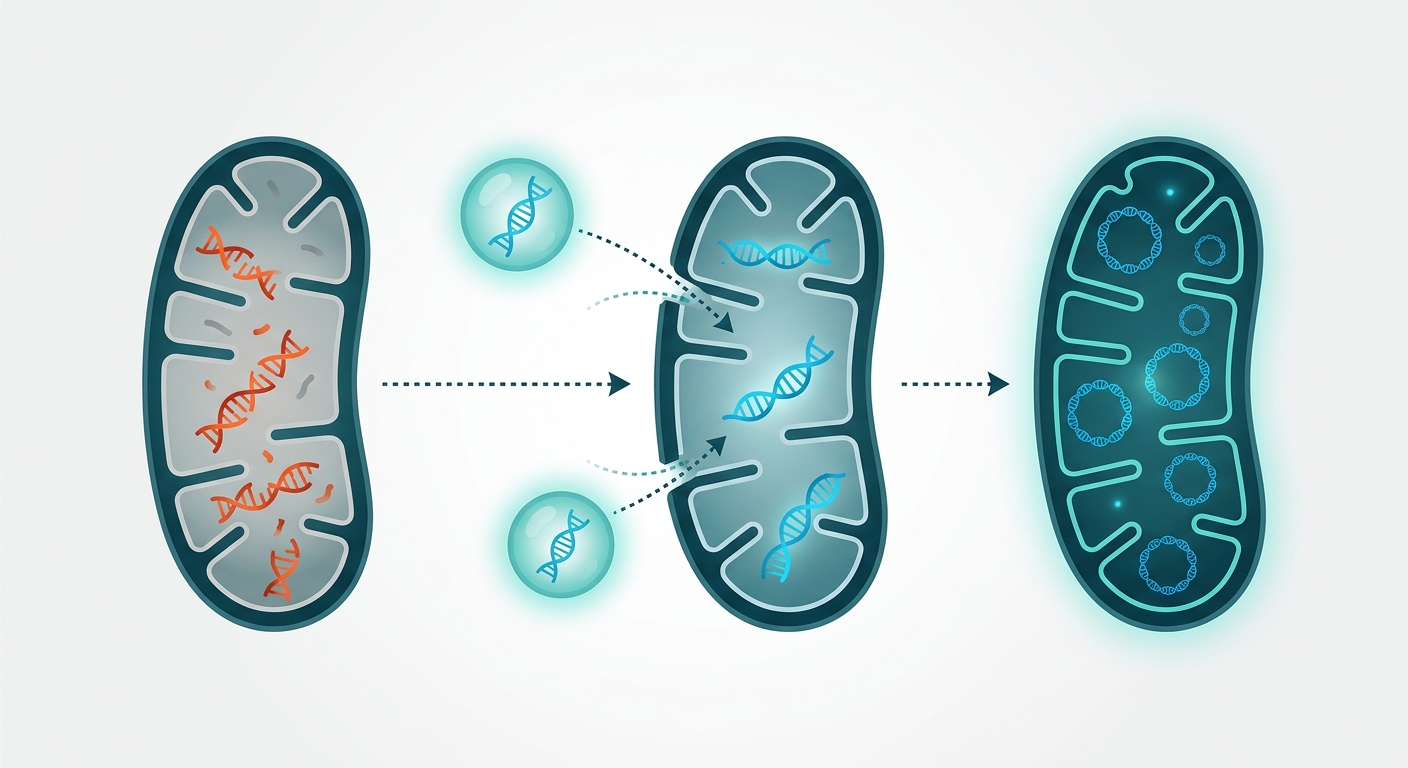
Deep inside almost every cell in your body, an ancient evolutionary alliance is faltering. Mitochondria—the cellular power plants that generate the energy for everything from a heartbeat to a thought—carry their own fragile, ancestral DNA. Unlike the secure vault of the cell's nucleus, this mitochondrial DNA (mtDNA) is highly prone to mutations. Over a lifetime, these genetic glitches accumulate, starving tissues of energy and driving the cellular exhaustion that we recognize as aging. For years, scientists have dreamed of using molecular "base editors" to correct these errors. However, the delivery vehicles used to carry these editors—such as plasmids or viruses—linger in the cell too long, turning a precision scalpel into a runaway chainsaw that causes widespread, off-target genetic damage.
To solve this, researchers have engineered a sophisticated biological Trojan horse: virus-like particles (VLPs). These are hollowed-out viral shells stripped of their infectious material, repurposed to act as microscopic delivery vans. In a breakthrough study published in bioRxiv, scientists bypassed the failures of traditional protein-delivery methods by engineering VLPs to package mRNA instead. Think of it as delivering a set of self-destructing instructions. Once inside the cell, the mRNA is translated into mitochondrial base editors (mtBEs), performs its therapeutic repair, and is rapidly degraded by the cell before it can cause collateral genomic damage.
Getting this biological machinery to work was an exercise in extreme nano-engineering. Early prototypes were sluggish, yielding editing efficiencies of less than 1%. To overcome this, the team iteratively redesigned the VLP structure and devised a clever molecular switch to quiet the editors while they were still inside the "producer" factory cells, boosting VLP potency by over seven-fold. The optimized mtBE-VLPs achieved a stunning 41% correction rate in human patient-derived cells and successfully installed pathogenic mutations in mouse cells with 88% efficiency. Crucially, compared to traditional DNA delivery, this transient approach slashed off-target genomic damage by up to 41-fold.
The ultimate test of any gene-editing technology is whether it can perform in a living organism. The researchers delivered the mtBE-VLPs via a single injection into the eyes of live mice, targeting the retinal pigment epithelium—a layer of cells critical for vision that is heavily affected by age-related degeneration. The particles safely edited an average of 12% of the mitochondrial DNA in these cells with virtually no off-target side effects. This proof-of-concept demonstrates that we can repair the cellular grid in vivo, bringing us one step closer to treating hereditary blindness and systemic metabolic diseases.
However, the road from a mouse's eye to a human clinic is notoriously fraught. While a 12% editing efficiency in the retina is a scientific triumph, it remains to be seen whether this threshold is high enough to reverse advanced clinical disease. More pressingly, the retina is an immunologically privileged, highly localized environment. Delivering these VLPs systemically to reach the heart, skeletal muscles, or brain—the organs most desperate for mitochondrial rescue in aging humans—will face massive physiological barriers, including rapid clearance by the liver and potential immune reactions. Scaling up the manufacturing of engineered VLPs with consistent quality also presents a major industrial hurdle. While this technology represents a giant leap forward in safety, we are still in the early chapters of clinical translation.
Sources & Citations:
Primary Source: Engineered mRNA-packaging virus-like particles enable efficient and precise mitochondrial base editing in vitro and in vivo (bioRxiv)
- Engineered mRNA-packaging virus-like particles enable efficient and precise mitochondrial base editing in vitro and in vivo. bioRxiv (2026). DOI: 10.64898/2026.10.04.756548