
Simulating the Summit: A New 'Hypoxia Pill' Offers a High-Altitude Shield Against Neurodegeneration
Imagine standing atop a windswept Andean peak, your lungs straining for oxygen. To the uninitiated, this thin air feels like a hazard. But to our cells, it is an ancient wake-up call. For years, scientists have observed a bizarre, counterintuitive phenomenon: subjecting the body to mild, continuous oxygen deprivation—hypoxia—can trigger a profound survival response, shielding the brain from the ravages of decay. Yet, prescribing a lifetime of high-altitude living or confining patients to low-oxygen tents is a logistical nightmare. Now, researchers have bridged this gap with a molecular magic trick: a second-generation 'hypoxia in a pill' that fools the brain into thinking it is on a mountaintop, rescuing damaged neurons without depriving a single lung of air.
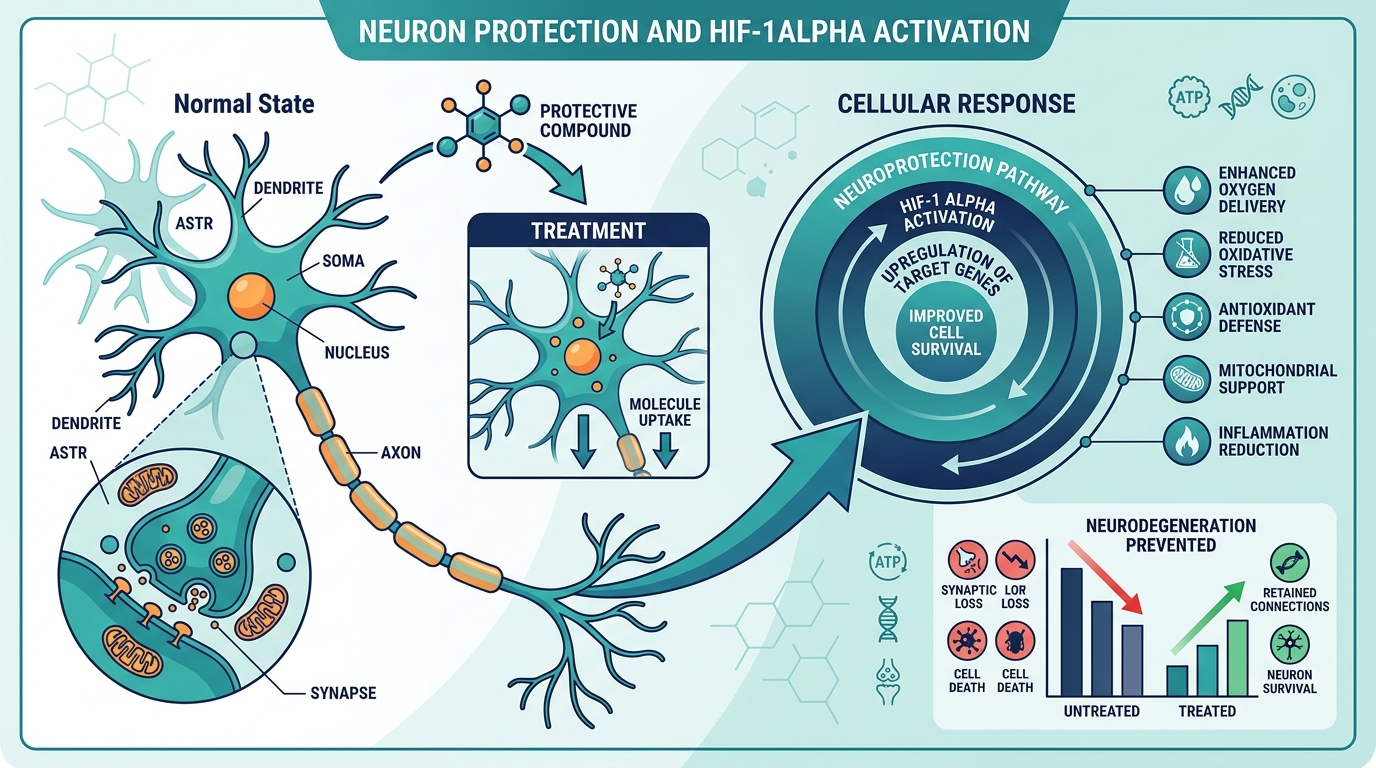
The secret lies in a molecular sensor called Hypoxia-Inducible Factor (HIF). Under normal, oxygen-rich conditions, our cells constantly dismantle HIF. But when oxygen levels drop, HIF stabilizes, acting as a master genetic conductor. It orchestrates a symphony of protective genes—reprogramming metabolism, boosting blood vessel growth, and shielding cells from oxidative stress. In a study published in the Proceedings of the National Academy of Sciences, scientists unveiled a highly optimized, brain-penetrant small molecule designed to selectively stabilize this pathway. Unlike its clunky predecessors, which struggled to cross the blood-brain barrier or caused systemic chaos, this second-generation compound acts like a master key, slipping directly into the central nervous system to quiet the molecular alarms of neurodegeneration.
To test the drug's mettle, researchers deployed it across distinct mouse models of neurodegenerative disease, which serve as biological proxies for human cognitive decline. The results were striking. Across different genetic backgrounds, the pill effectively reversed cognitive deficits and cellular pathology. It was as if the drug reset a blown fuse in the mice's brains, restoring synaptic plasticity and reducing the accumulation of toxic proteins. By bypassing the need for complex, continuous gas-delivery systems, the researchers demonstrated that the highly complex, multi-system benefits of physical hypoxia could be distilled into a simple, daily oral dose.
For biotech investors and longevity researchers, this discovery represents a profound paradigm shift. Rather than chasing single, disease-specific targets like amyloid plaques—an approach that has yielded decades of clinical heartbreak—this 'hypoxia-mimetic' targets the brain's fundamental, evolutionarily conserved survival machinery. It positions cellular resilience as a broad-spectrum therapeutic. If we can chemically train the brain to withstand the metabolic crises of aging, we might not just treat Alzheimer’s or Parkinson’s; we could fundamentally delay the cognitive decline that has long been accepted as an inevitable consequence of getting old.
However, the journey from mouse cages to human clinics is fraught with biological traps, and this 'hypoxia pill' is no exception. While the results in mice are spectacular, the human brain is vastly more complex, and human trials of neuroprotective drugs have a notoriously high failure rate. Moreover, playing with the HIF pathway is a double-edged sword. Chronic HIF activation can stimulate the production of red blood cells, potentially thickening the blood and increasing the risk of strokes or cardiovascular events. There is also the haunting shadow of oncogenesis: cancer cells frequently hijack HIF pathways to survive and thrive in oxygen-poor tumor microenvironments. Navigating this narrow therapeutic window—delivering enough neuroprotection without triggering off-target cardiovascular or oncogenic dangers—will be the true, Herculean test for this next generation of longevity therapeutics.
Sources & Citations:
Primary Source: A second-generation "hypoxia in a pill" rescues neurodegenerative phenotypes across distinct mouse models. (Proceedings of the National Academy of Sciences of the United States of America)
- Primary Paper: "A second-generation 'hypoxia in a pill' rescues neurodegenerative phenotypes across distinct mouse models." Proceedings of the National Academy of Sciences of the United States of America. https://doi.org/10.1073/pnas.2618654123